The Plan of the Apes Paper to Draw
/https://tf-cmsv2-smithsonianmag-media.s3.amazonaws.com/filer/e6/a2/e6a2b95b-03e6-471a-a8aa-1242415a615b/1024px-500px_photo_188689983.jpeg)
A new survey of 47 chimpanzees, bonobos and organgutans suggests swell apes draw on personal experience to infer others' deportment, exhibiting a skill once thought to be unique to humans.
As researchers led by Fumihiro Kano of Japan's Kyoto University report in Proceedings of the National Academy of Sciences, the findings add to a growing torso of bear witness indicating non-human animals possess "theory of mind," or the ability to attribute mental states—including beliefs, desires and knowledge—to oneself and others.
According to Cosmos' Tanya Loos, the study builds on a 2016 investigation besides co-authored by Kano. The previous paper, published in the journal Science, showed that great apes are capable of recognizing when others are operating under a simulated fix of assumptions—a key component of theory of mind.
To determine primates' capacity for understanding false belief, Kano, atomic number 82 coauthor Christopher Krupenye of Duke University and their colleagues conducted a serial of anticipatory looking tests. In the 2016 experiment, corking apes watched videos of humans—one dressed as a gorilla—hiding an object and so guessing where information technology was. I video showed the gorilla-adapt role player hiding an object while another homo watched. The person so had to guess where the object was hidden. A second video showed the gorilla-suit actor hiding an object after the other human being left the room. When the person returned, they had to guess where the object was hidden.
In total, 17 of 22 apes tested—as judged by their centre gaze—correctly predicted that the subject would search in the original hiding identify if the item was moved without their noesis.
As Cosmos ' Loos reports, the latest written report corrobates the 2016 findings while challenging a proposed explanation for the great apes' accurate assessments. The previous work suggested that the animals followed the and so-called "behavior rule," which means the smashing ape probably merely chose the last location seen, rather than genuinely comprehending the amanuensis'southward state of heed.
To debunk the beliefs rule explanation, Kano and his fellow researchers used a revised version of the original 2016 experiment. According to Cosmos' Loos, the apes were get-go familiarized with opaque and translucent barriers.
So the researchers repeated the video trial while the apes wore a visual tracking device and sipped juice. The slap-up apes watched an actor dressed like a monkey—nicknamed Kong—hide an object underneath one of two identical boxes as some other human actor watched. Next, the actor stood backside a barrier while Kong moved the detail. While moving the object, Kong first switched it from the original "target" box to the second "distractor" box and and so removed it completely. When the other thespian returned, they paused betwixt both boxes for several seconds before ultimately choosing one.
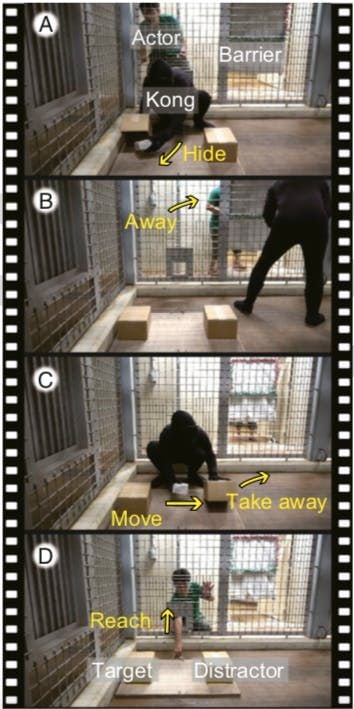
Apes shown an opaque barrier focused their gaze on the target box, operating under the assumption that the human histrion would search the surface area in which they had terminal seen Kong hide the object. Those shown a translucent barrier, meanwhile, exhibited no preference, instead acting as if the subject area knew the object had been removed and would therefore non search in any specific location. Hypothetically, the apes were recalling their experiences with barriers and assuming the human was experiencing the aforementioned thing. (Or as the idiom goes, the apes were able to "take a walk in their shoes," or put themselves in that state of affairs based on prior knowledge and apply it to what the actor experienced.)
Per a press release, the findings refute a purely behavioral explanation considering both groups of neat apes predictable the actor'south decisions based on their personal experience with the barriers rather than simply post-obit Kongs' actions.
"These results together corroborate the idea that … nonhuman animals have a theory of mind and do not simply rely on behavior rules to interpret and anticipate others' actions," the authors write in the study.
Every bit Kano concludes in the press release: "We are excited to find that swell apes actually passed this hard test. The results advise that we share this ability with our evolutionary cousins. We plan to keep refining our methods to examination farther non-mentalistic alternatives to the theory of mind in nonhuman animals."
Source: https://www.smithsonianmag.com/smart-news/great-apes-draw-experience-anticipate-others-actions-180973249/
0 Response to "The Plan of the Apes Paper to Draw"
Post a Comment