Small, Family Operated Business Make Up How Much of the Economy in the Us Compared to Corporations
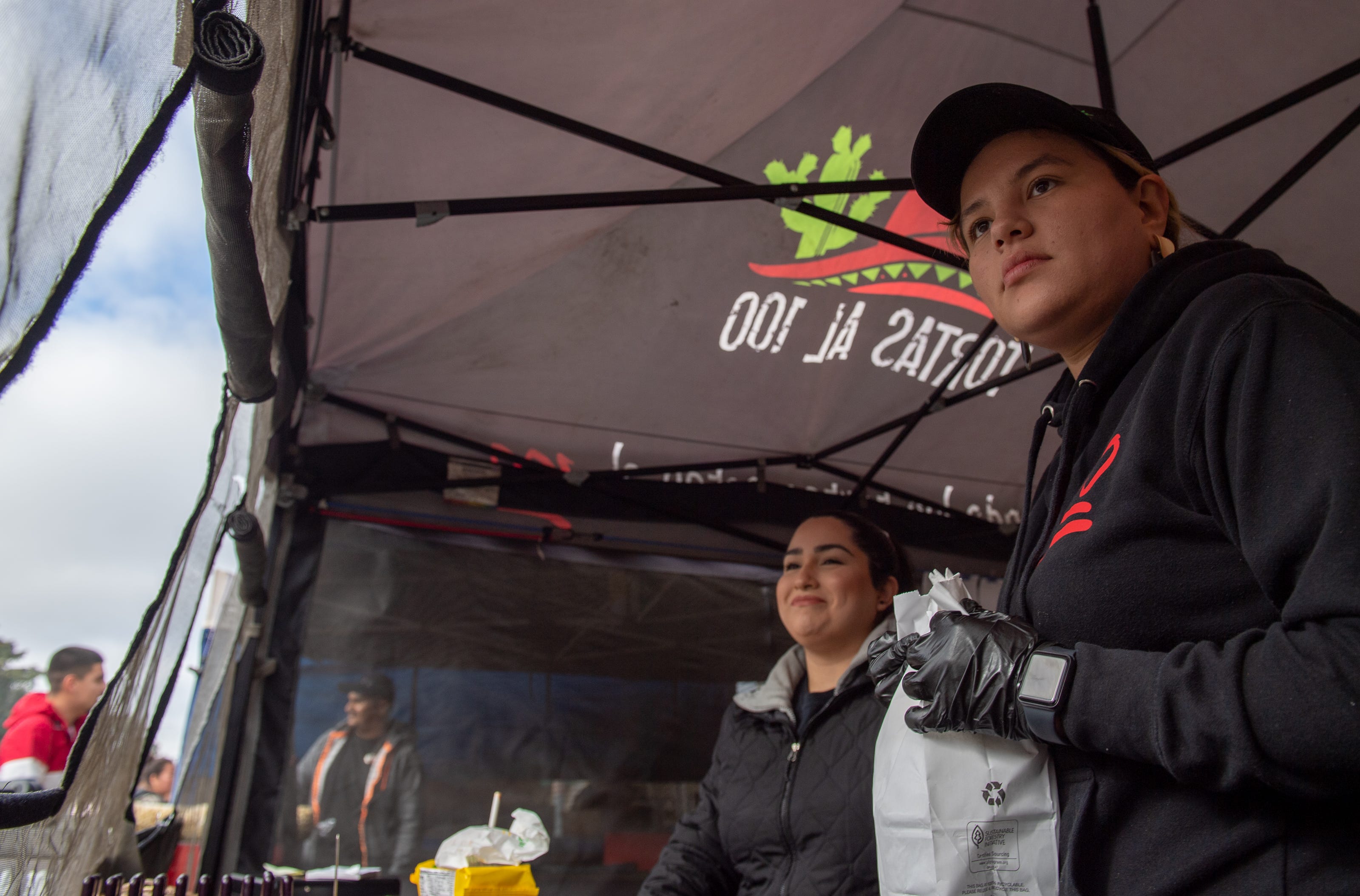
Orlando Osornio owner of Tortas Al 100 poses for a portrait Feb. 12, 2020, exterior his Salinas abode. Osornio started this business for his honey of food and the potent ties he has to the customs of Salinas. David Rodriguez/The Salinas Californian
Leer en español
The Usa TODAY Network series Hecho en United states, or made in America, focuses on the nation's growing Latino customs. Roughly fourscore% of all Latinos living in the U.Southward. are American citizens, merely media coverage of Hispanics tends to focus on immigration and criminal offense, instead of how Latino families alive, work and acquire in their hometowns. Hecho en USA tells the stories of the nation'southward 59.ix million Latinos – a growing economic and cultural force, many of whom are born in the U.S.
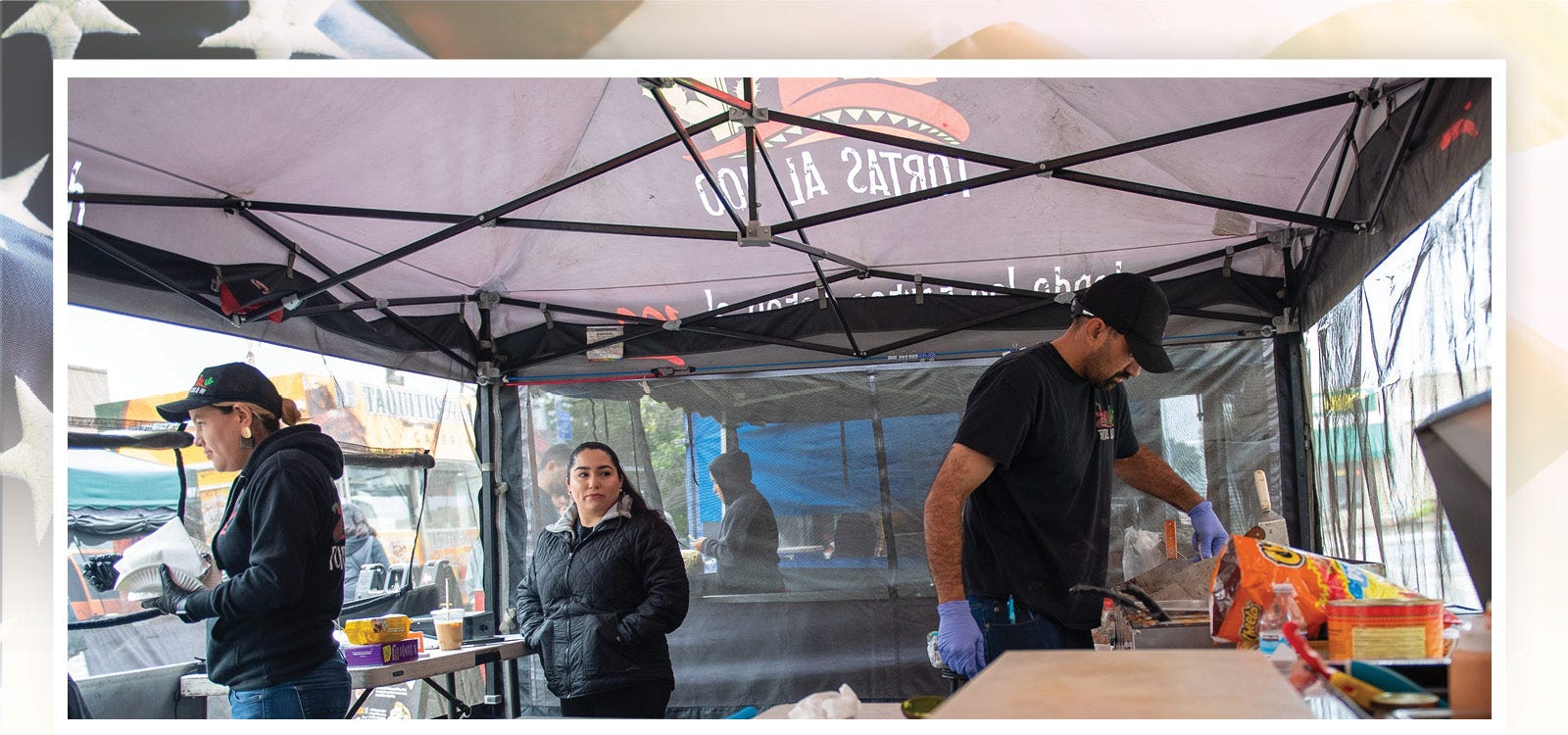
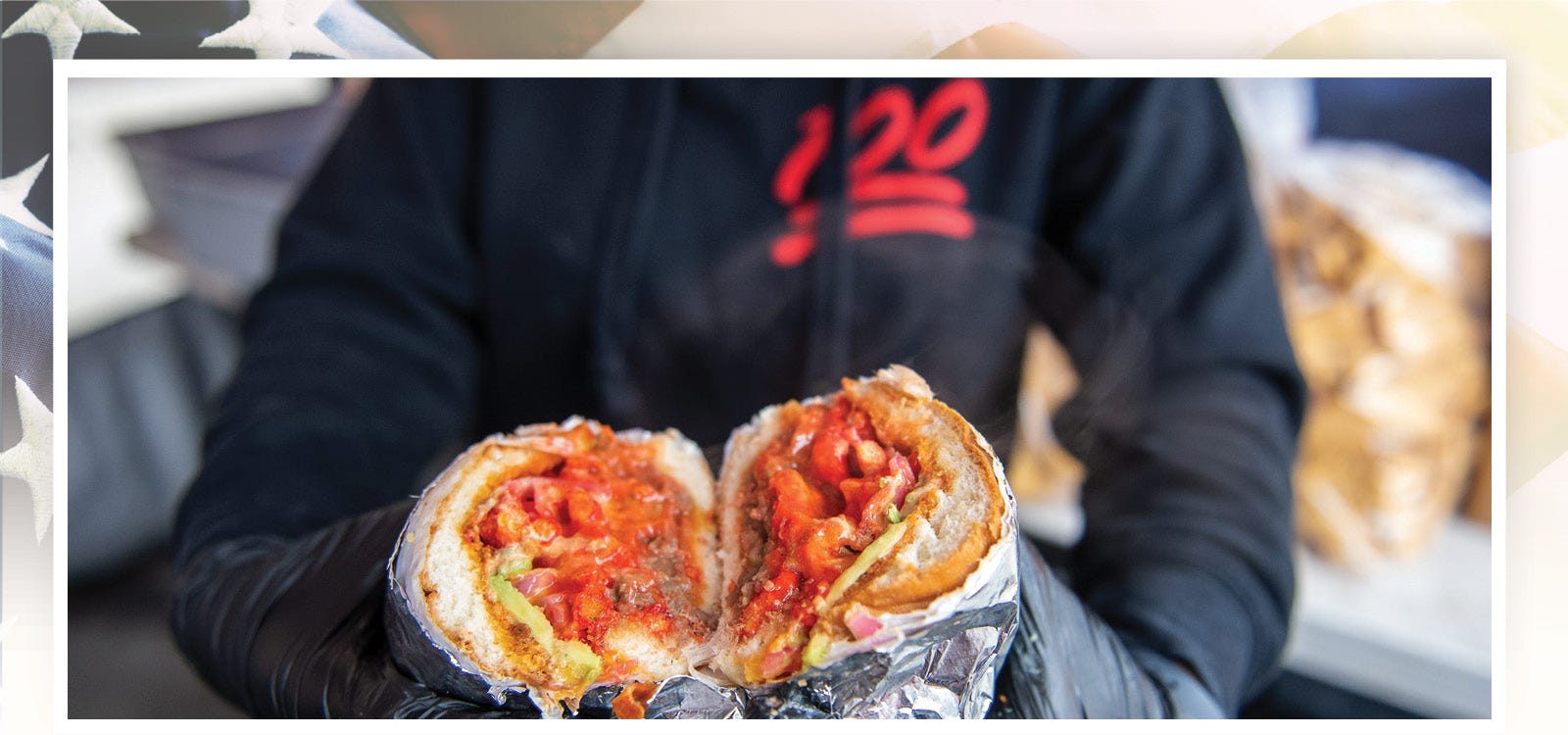
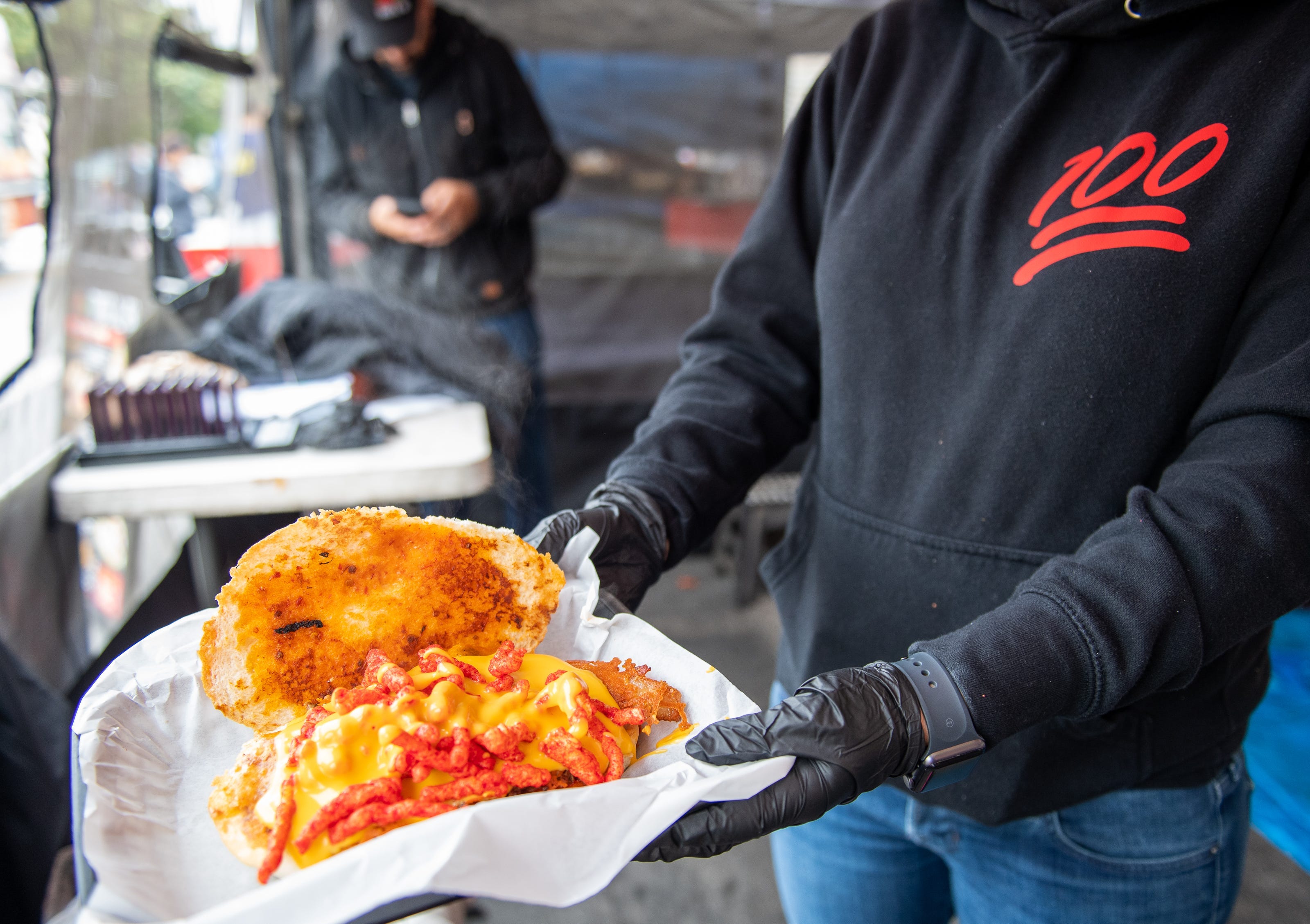
SALINAS, Calif. – On the weekends, nutrient truck owner Orlando Osornio, thirty, and his wife, Denise, sell mile-loftier tortas, filled with California fusion-inspired ingredients: hot Cheetos, bacon, mango-habanero sauce, or pineapple. Some come for the birria torta, or the craven-salary-alfredo torta.
A line of customers winds its way around the side of his tent as meat sizzles on the grills. On the other side of the mesh, Osornio and his crew pack and stack toasted buns equally fast as they can.
Ii years ago, when Osornio, who is Mexican-American, was contemplating launching Tortas al 100, he knew one thing: He didn't want to apply for a loan. Osornio had racked up "about $thirty,000" in credit-card debt as a teenager and said when life smacked him in the face in his early on 20s, he got serious almost paying it down and fixing his credit score.
That experience, he said, was what prompted him to forgo applying for a small-scale-business concern loan. Instead, Osornio estimated he and his wife spent at least $50,000 of their salaries on the burgeoning business, including food, 4 grills and a tent, during its starting time year of operation.
Report: Latino-owned pocket-sized businesses are outpacing U.S. economy
Latino small business owners are the fastest-growing group of entrepreneurs in the U.S. even every bit they boxing systemic racism.
USA TODAY
Latino pocket-size-business owners like Osornio are the fastest-growing group of entrepreneurs in the U.S. fifty-fifty every bit they boxing systemic racism that has resulted in lower incomes and loan rates. Over the past 10 years, the number of Latino business owners grew 34%, compared to 1% for all business owners in the United States, according to a recent study from Stanford University. And more Latinos than ever are applying for small business loans to launch or abound their operations.
The growing success of Latino small business owners comes every bit Latinos are increasingly condign an economic force in the U.Due south. The same Stanford study found Latino-endemic businesses contributed about $500 billion to the economy in annual sales.
A 2019 report to Congress based on data from 2017 found almost sixty million Latinos in the United states already account for $2.3 trillion in economic activity in total, which on its own would rank every bit the eighth-largest economic system in the world. And Latinos are projected to make upward 30% of the U.S. population by 2020, meaning the grouping's contributions are only likely to grow.
Latino-endemic businesses utilize more than 3 million people, according to the 2019 Country of Latino Entrepreneurship study by the Stanford Latino Entrepreneurship Initiative (SLEI), a Stanford University research initiative centered effectually Latinos in business organization. All told, Latino-endemic businesses account for about 4% of U.S. business concern revenues and 5.5% of U.South. employment.
However, Latino-owned companies remain smaller than white-owned firms, averaging $one.two 1000000 in acquirement compared with $2.3 million brought in past a white-owned company. That is a problem, said Jerry Porras, a professor emeritus of organizational behavior and change at Stanford Business School; co-founder of the Latino Business Action Network, a nonprofit out of Stanford University focused on empowering Latino business concern owners; and co-managing director of SLEI.
"I think that there'south really a positive story when y'all look at Latino businesses across the country," he said. "The number is smaller as a base merely it's growing very rapidly. Latinos are oriented towards starting businesses and are doing it at a significant rate."
If Latino-owned employer firms were given the same chances, Porras said, they would generate an additional $iv billion in revenue and 1 one thousand thousand jobs.
Latino small business organisation owners tend to exist younger
Across the U.S., Latinos are represented in all the major industry sectors, owning businesses in manufacturing, education, health services, finance, construction and more.
Latino business owners tend to be younger than non-Latino business owners. Roughly 33 percentage of Latino entrepreneurs are younger than 45, compared to merely 22% of non-Latino entrepreneurs.
For every 100,000 Latino adults in the U.s.a., on average 510 became entrepreneurs each month in 2018.
Nevertheless, research by the Found on Assets and Social Policy, an found that studies economical opportunities for people of color, shows that historic disenfranchisement of people of color has led to those very people having less generational wealth than white people.
When Latinos take been able to purchase homes, they have historically been relegated to neighborhoods where the homes didn't take every bit much value and so they're unable to build as much wealth and pass it on.
Furthermore, policies that favor the affluent have connected to widen the gap, especially between white families and black or Latino families.
While the income gap between blacks and whites closed somewhat between 1970 and 2016, Hispanics fell even further behind at all income levels, the Pew Enquiry Centre retrieve tank found in 2018. Even top-earning Hispanics earned merely 65% as much every bit whites in 2016, down from 74% in 1970.
And Hispanic people on average continue to have lower salaries than white people, research out of Stanford showed.
In the finish, this combination means Latinos typically have lower credit scores, which can mean higher involvement rates or being turned down for loans.
Co-ordinate to a written report submitted to the U.Due south. House Financial Services Committee in 2019 by UnidosUS, a nonpartisan think tank focused on the Hispanic customs, banks originally had loan officers who determined the "trustworthiness" of a loan applicant. As such, people of color were often discriminated against.
In the following decades, banks lost their loan officers to the war endeavour, and soon invented credit scores equally a stand-in. Nonetheless, these, too, had their issues equally they were built on longstanding disparities and have resulted in communities of color, young adults, people with low incomes and immigrants having unduly low credit scores.
Co-ordinate to the 2017 Small-scale Business organisation Credit Written report past the Federal Reserve Banks, of applicants denied credit, 45% of Latino applicants were turned downwards for insufficient credit history and 37% for having too depression a credit score. (Applicants could cull more than 1 response.) In comparison, white applicants were turned away at rates of 33% and 26%, respectively.
"I think the Latino story in some ways follows the story of why blackness families have less wealth than white people today," said Urban Institute research young man Steven Brown. "At that place is a lack of the same kind of resources that help build wealth."
Brown cited restricted admission to homeownership under policies such as "redlining" equally a primary way Latinos were kept from edifice generational wealth. For decades, blackness and Latino neighborhoods were unfairly accounted too risky for loans and mortgages through redlining. That left people there reliant on speculators or private sales.
"When Latinos have been able to buy homes, they have historically been relegated to neighborhoods where the homes didn't have equally much value, so they're unable to build as much wealth and pass it on," Brown said.
In more contempo years, as Latinos take become more than prominent in U.S. civilization, their economic continuing has risen.
A 2019 study of 61,000 small-concern loan applications submitted to Biz2Credit's online marketplace plant the number of credit applications from Latino-owned businesses rose 23 percent from 2018 to 2019.
And over the terminal year, Latino-owned businesses reported an average revenue growth of xiv%, outpacing the growth of the U.Southward. economy, the Stanford report showed.
While revenues climbed, though, the average credit scores of Latino business owners dipped to 588 from 594 terminal yr, according to Biz2Credit.
According to Biz2Credit CEO Rohit Arora, that could indicate business concern owners are using personal credit cards to fund their business growth if their companies did not qualify for loans. Furthermore, cost management can exist difficult for immature businesses, and that may factor into the dip in scores.
"When credit scores are less than 600, information technology is hard to get traditional depository financial institution loans," Arora said in the report his firm released.
Porras said the lack of credit can forcefulness Latino business organization owners to make riskier financial decisions, such every bit relying on personal credit cards to grow their concern or taking out a loan on their accounts receivable.
"By and large, I remember Latinos are very unsuccessful in securing loans from the more professional sources," said Porras.
"It'south the smaller ones that are hurting the most," he added, referencing business organization size.

Less trust of financial institutions
In other cases, Latino borrowers may exist less trusting of financial institutions as a whole, based either on past experiences or a general understanding of systemic racism past lending institutions.
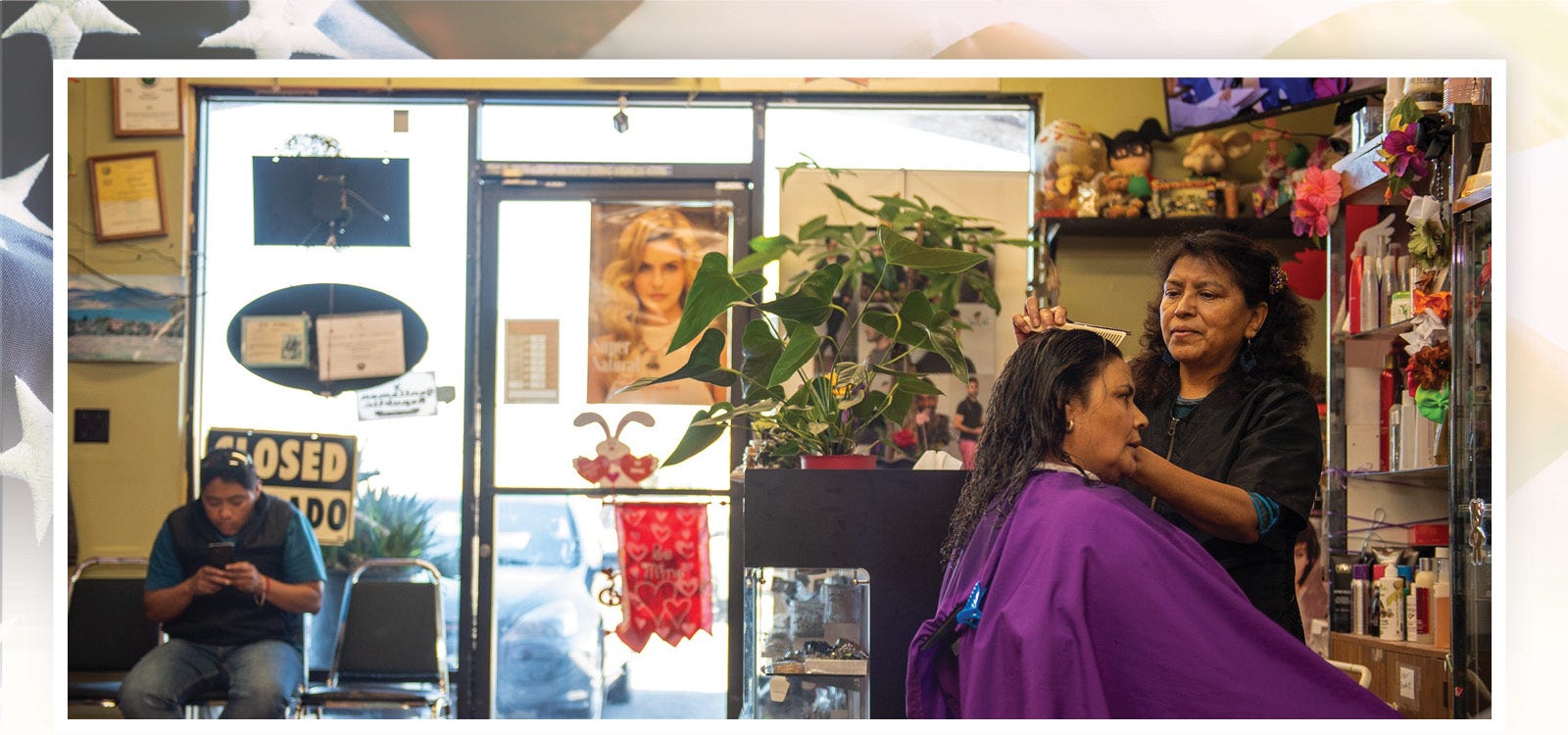
"Latinos have to pay more for interest," said Fausta Ibarra, 59, who owns Tropical Cuts pilus salon in Salinas, California. "We accept to pay more for everything."
Ibarra, who calls herself a "cien por ciento" -- or 100% -- Mexican adult female, had poor credit after bug with a firm she and her sisters bought together in the early 1990s. When she applied for a loan in 1993 to open her hair salon, a brightly lit salon tucked into a small strip mall in Salinas, Washington Mutual Banking concern denied the loan. (The banking company collapsed in 2008 during the financial crunch.)
She ended upward borrowing nearly $30,000 from friends, family and coworkers, slowly paying them back i by one.
I exercise think that Latinos can contribute more to this country if they give us the same opportunity to better ourselves and our children. I think we all desire to progress, but they don't give us the same tools they requite someone who was built-in here.
When Ibarra tried to purchase a home in 1996, her low credit still held her dorsum. At that place was, however, another way, the real-estate agent told her. Ibarra ended up paying more than the firm was on the marketplace for, and she had to borrow from friends and family unit so she could put down a eolith of $10,000, twice what she was prepared to pay out of pocket.
Ibarra felt taken advantage of.
"Los Latinos tienen que ganarse el pan cada día," said Ibarra in her native Spanish. "Yo sí pienso que los Latinos pueden contribuir más si nos dan la oportunidad para sacar adelante a nuestros hijos. Yo pienso que todos tenemos las ganas de progresar pero no se nos dan las facilidades que se les da a una persona ciudadana de aquí."
That translates in English to: "Latinos have to start all over over again, every solar day," Ibarra said. "I practise think that Latinos can contribute more to this country if they give usa the aforementioned opportunity to better ourselves and our children. I think we all want to progress, but they don't give united states of america the same tools they give someone who was built-in here."
Discriminatory lending practices continue
Today, black people and Latinos go along to be routinely denied conventional mortgage loans far more often than their white counterparts, according to Dwelling house Mortgage Disclosure Deed records analyzed by Reveal for The Center for Investigative Reporting in 2018.
The analysis showed blackness applicants were turned abroad at significantly higher rates than whites in 48 cities, and Latinos in 25, fifty-fifty when controlling for loan size, neighborhood and income.
In other instances, black or Latino applicants were steered toward college-price, riskier loans.
Bank of America, for instance, agreed to a $335 one thousand thousand payout to the Justice Department on behalf of its mortgage lender, Countrywide. Prior to Bank of America'due south purchase of the lending establishment, Countrywide purposely charged 200,000-plus black and Latino borrowers more than for their mortgage loans than white borrowers with like qualifications between 2004 and 2008.
The lender brash those borrowers of color to take out risky subprime loans, even when they qualified for prime loans, or but charged them higher rates.
Other lending institutions, such as Wells Fargo, have had similar claims levied against them.
Latinos plow to friends, family for seed money
According to the 2019 Stanford written report, Latinos get loans from local banks at a much higher rate than they practice from national banks.
However, local banks are disappearing across the United States, potentially leaving Latinos out in the cold. According to data provided by the Federal Eolith Insurance Corporation (FDIC), as of December. 31, 2001, 8,080 FDIC-insured community banks existed in the country. By Dec. 31, 2018, 5,406 remained.
"The local banks are tied to the community more tightly," said Porras. "If the customs has more Latino businesses, the relationships are built up and they abound. National banks lag backside there because local banks work harder to network with the businesses in their communities."
When local banks are not bachelor, instead of applying to larger loan institutions, many Latinos turn to friends, family and crowdfunding for seed money.
In Salinas, a pocket-size city surrounded by rich agricultural land, U.S. Census Bureau data shows 78.7% of the some-156,000 residents are Hispanic or Latino. While the metropolis's agricultural manufacture thrives financially, thanks to the tens of thousands of Latino farmworkers that menses in and out of Salinas every year, the boilerplate farmworker takes domicile simply $17,500 a yr, according to the U.Southward. Section of Labor. More than than 17% of its residents live in poverty.
I think the Latino story in some ways follows the story of why black families have less wealth than white people today. At that place is a lack of the same kind of resources that help build wealth.
Still, Latino entrepreneurship is evident in Salinas. Latino-owned restaurants, barbershops, grocery stores, showrooms and more take risen out of the landscape all over town, tucked into plazas and surrounding big box stores. About thirty% of all businesses in Monterey Canton, where Salinas rests, are endemic by Hispanic or Latino people, per data provided by the Monterey County Workforce Development Lath from the 2012 American Community Survey.
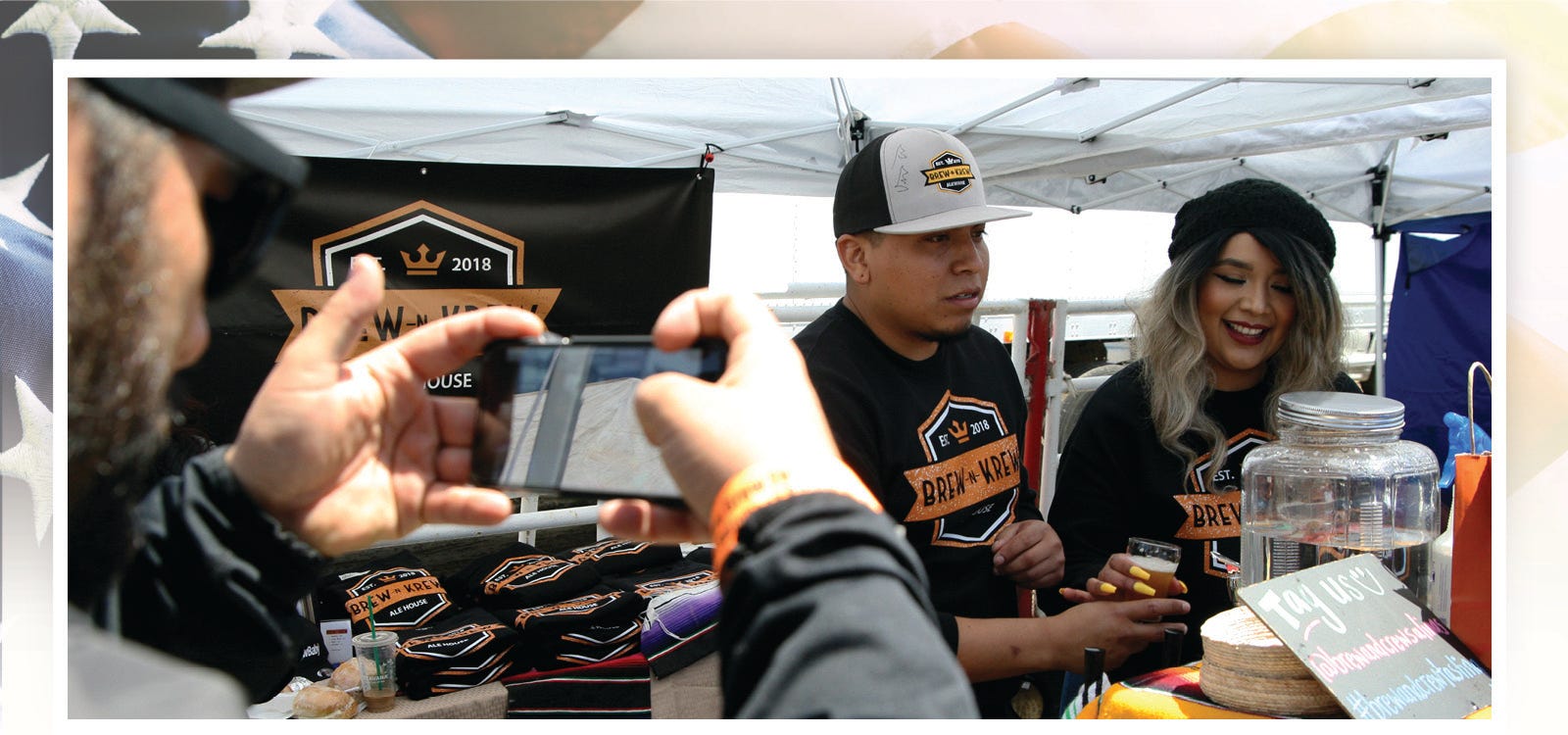
Marlene Garcia, 29, is the proprietor of a homebrew operation turned commercial brewery that volition open in Salinas in the jump. She borrowed $210,000 from her female parent to commencement upwardly her operation.
Salinas'due south downtown is but iii blocks long, simply Garcia's brewery, Brew & Krew, will open up on the 100 block of Main Street, near four other Latino-owned businesses that have opened (or reopened under new ownership) in the past two years. The growth is notable on a side of town that is historically inhabited primarily past white residents.
"I am honestly so thankful for my parents, both of them," said Garcia, reminiscing nigh her parents' insistence that she help with the family unit businesses.
Her parents, Graciela and Gildardo, worked in fields after immigrating to the U.S. from Guanajuato, Mexico. Every month or then, they would go to Los Angeles, v hours abroad, to stock up on Mexican processed, piñatas and cassette tapes, Garcia said. Then, they would plow around and sell them at the Santa Cruz weekend flea marketplace in central California, dragging their children with them.
It was at that place that Garcia learned the dedication information technology took to run a concern, even as she told her parents she never wanted to own her own functioning.
"Growing up, my unabridged life, we would go to the flea marketplace," said Garcia. "We'd wake up super early, drive to Santa Cruz, and work. I remember telling my parents, 'I don't want this, I don't want to go into concern.'
"Now that I'thou older, I appreciate everything they did. I run into why they did that."
The Garcias opened some other stand in another flea market, and so a taquería. Finally, they sold all their businesses and took out their first loan of $80,000 to open a liquor store in Gilroy, a small bedroom customs 30 minutes south of San Jose. They named the store La Flor de Jalisco.
I am honestly so thankful for my parents, both of them. ... Because of them, because of the way they saved, considering they saved, a lot of the money that has been invested came from my mom.
When Garcia wanted to open her own brewery, her mother became her silent business partner.
"Because of them, considering of the way they saved, considering they saved, a lot of the coin that has been invested came from my mom," said Garcia.
Garcia is in the process of applying for her get-go loan — a Small Business Assistants loan for $480,000 to open up her business concern. She credits her mother'south help in assuasive her to so far not rack upwards debt and interest rates.
Although the space is nonetheless unfinished, Garcia has big plans for her small brewery. She wants large, stainless steel canisters in the back, behind a large pane of glass and so brew enthusiasts tin can sentry the brewers at work every bit they sip on suds.
She hopes to connect with other business concern owners in the area to cantankerous-promote, whether it be with the cinema next door or the sandwich store across the street.
"Hispanic parents are never excited to hand out money," Garcia said, laughing. "But she believed in it, she saw that people really do like my beer. If she wouldn't seen that reaction, it would have been harder to convince her."
'Puro cash'
Osornio's family has a saying whenever they have to pay for something. "Puro cash," they repeat, laughing, or pure cash in English.
The joke is based on Osornio'south father. Years ago, when he was purchasing a car for his wife, the salesman asked him if he wanted to finance.
"No," said Osornio the elder. "Puro cash."
Despite the financial savvy his father displayed, Osornio said his parents rarely talked money direction with him. All he recalls was being told credit cards were for emergencies merely, a lesson that, similar many teenagers, he immediately disregarded as soon as he got one of his ain.
By and large, I think Latinos are very unsuccessful in securing loans from the more professional sources. It's the smaller ones that are pain the most.
The feel of wiggling out from under a pile of debt taught Osornio that he wanted applying for a loan to exist "a final resort."
Years later, Osornio has managed to build such a successful business with his unique torta recipes that he routinely fields offers from locals to invest in or outright purchase his business -- and his recipes -- from him.
And that, advocates have said, is the subconscious silver lining for Latino entrepreneurs: even more untapped potential.
Co-ordinate to a 2017 New American Economy report on the power of Hispanics in the U.Southward., Hispanic entrepreneurs own a large chunk of transportation and warehouse businesses, laying merits to more than twenty% of the industry in 2012. They as well owned about 12% of the land's construction firms.
Advocates say that, given a risk, Latinos could abound their portion of the economy fifty-fifty further. Nevertheless, the "opportunity gap between Latinos or Hispanics and their white, business-owning counterparts is wide.
"Wealth is the missing ingredient in the Latino community," said Porras. "If we could add more wealth, people would swallow more than and grow the economic system. How do nosotros get more wealth? Grow businesses."
"It'southward a synergystic procedure," said Porras. "In the long term, it volition benefit the whole land."
All Latinos need, Porras said, is a chance.
Kate Cimini is a multimedia journalist for The Californian. Call her at (831) 776-5137 or electronic mail kcimini@thecalifornian.com.
- More US schools teach in English and Spanish, but not enough to assistance Latino kids
- More Latino students than e'er are trying to get their degree, but it'south fraught and costly
- Latinos make upward only 1% of all local and federal elected officials, and that'due south a big problem
- Before Super Bowl, Miami'due south Footling Havana faces exodus of Cubans, pressure level from developers
- Latinos are opening more small businesses than anyone else in the US
- 25 years after her expiry, vocalizer Selena inspires fans across the U.s. to pursue their dreams
- Coronavirus' online school is hard enough. What if y'all're still learning to speak English?
Source: https://www.usatoday.com/in-depth/news/nation/2020/02/24/latino-small-business-owners-becoming-economic-force-us/4748786002/
0 Response to "Small, Family Operated Business Make Up How Much of the Economy in the Us Compared to Corporations"
Post a Comment